
Culling Words
Editing poetry is truly killing your darlings

After my sister died, the glut of words I wrote while traversing her year-long battle with breast cancer humbled me. Gratitude for each instance stolen to write during a long, dark time of struggle enshrined each piece like a sacred text. I tried to edit a few and publish early on, but they failed just like that cake you check on too many times. I put them away.
More than a year later with three, additional rotations of group therapy through GriefShare and lots of counseling, I am rereading, editing, and cutting while compiling a larger collection. I hesitate to cut without keeping.
I need to cut without keeping.
The temptation to keep everything goes back to that hoarding impulse that plagues so many. When we hurt, so many of us ball up into an infant curl and pull in the comforting things: blankets, pillows, old sweaters, crockery, or mountains of useless detritus like baseball hats, records, newspapers, mail mixed with takeout trash—all covered in cat hair and cigarette ashes. (Sorry—I have untangled a hoarder house.) Sure, there are treasures. A few.
Every idea is not sacred. Every word is not brilliant or even good. Some of mine were so bitter—a distillation of the confusion and panic we were trapped inside. At least those feelings and impressions were released onto a page instead of spewed into the air.
Culling is the separating and destruction of the poorly formed or diseased. As a humanist, the loss of the broken feels sacrilegious. We are all of our broken places. We learn through struggle and failure.
In writing poetry which is so spare, so condensed, culling is life. Without the cutting, there is no distillation.
In the garden this year, I was fooled by a plant that survived our hellacious winter into thinking it was Italian parsley. The plant identifier agreed with me. I was enamored with its spear-shaped greens poking so bravely out of weedy overgrowth as I prepared the bed. Yesterday I checked its voracious growth and looked again. It must be a weed. Kill your darlings? Yes? No.
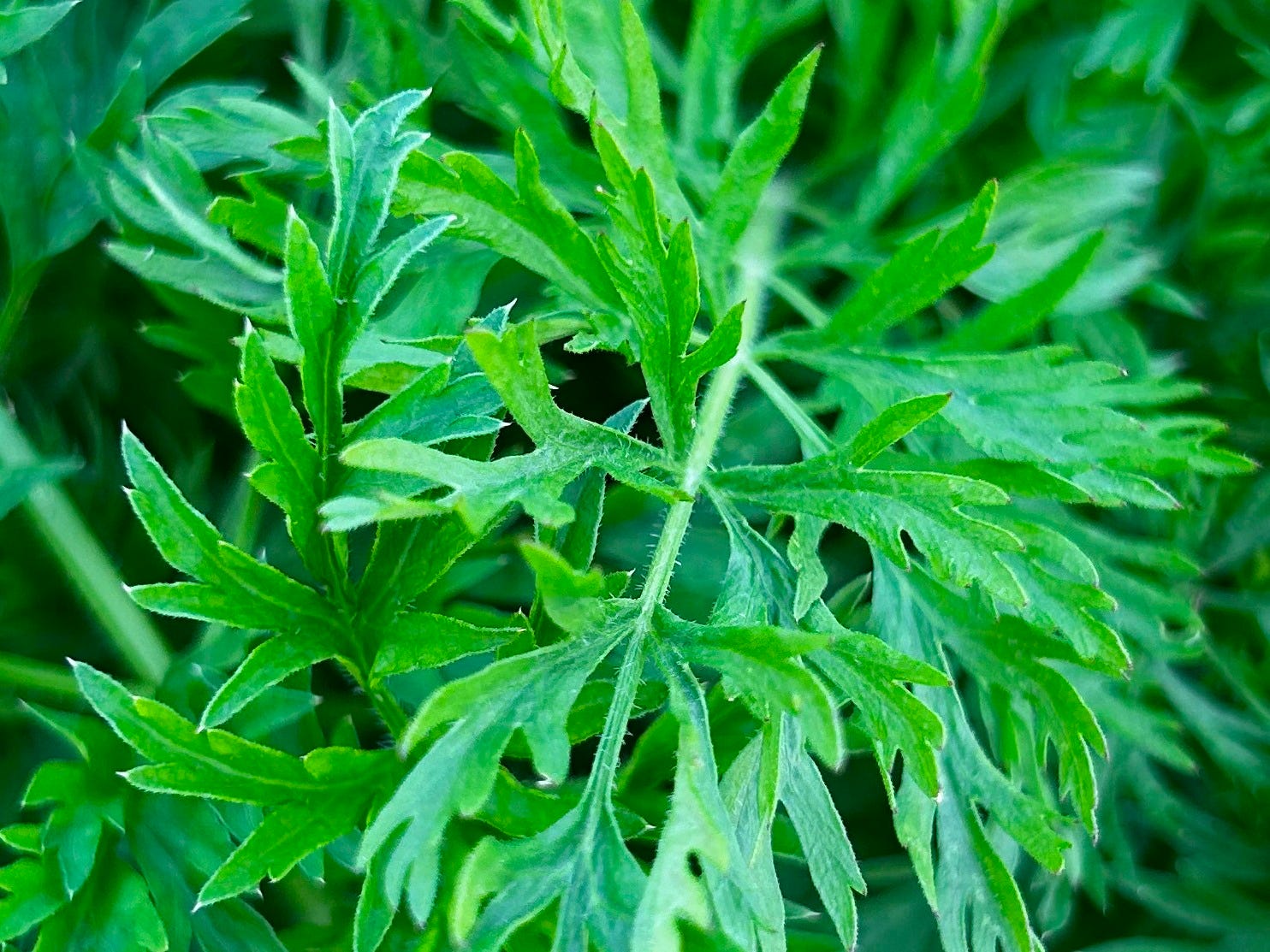
More research beyond knee-jerk AI revealed that seseli libanotis, commonly referred to as moon carrot or mountain stone-parsley has taken root. It’s edible and useful in honey production and can be used as an anti-malarial.
Have I mentioned the garden plot I tend is less than a hundred yards from three hives of thriving honey bees? A little bit of hesitation and more research keeps the moon carrot beast for another culling moment when it creeps into the tomatoes. Tended instead of ripped out.
And so with words. Ideas. I am trying to squeeze the good out of darkness because it is there. Patience is required. Time helps, but standing back on the few I have harshly dashed through is temptation.
During a meeting last week, Psalm 61 offered this snippet: “When my heart is overwhelmed;/ Lead me to the rock that is higher than I.” Time offers perspective. Experience offers insight. When can I trust my judgement of silver versus dross?
So I offer this poem snatched from the culling. It is bulky, knobby, and ill-formed. It returns me to a weedy thought not yet ready for uprooting. You can see what is cut and what is saved. The original was a bulky slew of paragraphs lined like the first, deleted stanza.
Happy editing.
On to the culling.
Hemingway Advises
WRITE HARD AND CLEAR ABOUT WHAT HURTS. Ernest Hemingway
Yes, I think, when the old saw by Hemingway scrolls through.
Facebook missives on life and truth
On a platform where people inflate and promote shadows.
All puppets and farces, fiction and invention.
The hurting part? A no-brainer.
That’s how we learn, after all.
The falling down and skinning knees
or scuffing chins or breaking teeth.
Those are solid, good lessons.
We all have them.
What is ignored,
the key to H’s advice,
is “HARD” and “CLEAR.”
When the words dribble
onto the page
in a fit of whimsy,
that’s a soft start.
The work is in the polishing,
the culling, the carving.
The requirement of clarity
when scribingsomething thatmuddies,
claws and scrapes at the mind,
the character,
the fabric of the tale,
cut.
Clear and hard words
for the rending pain
that pits the soul.